
BitcoinWorld
RedotPay Shuts Its Door in South Korea as the Crypto Tax Clock Ticks
Key Takeaways
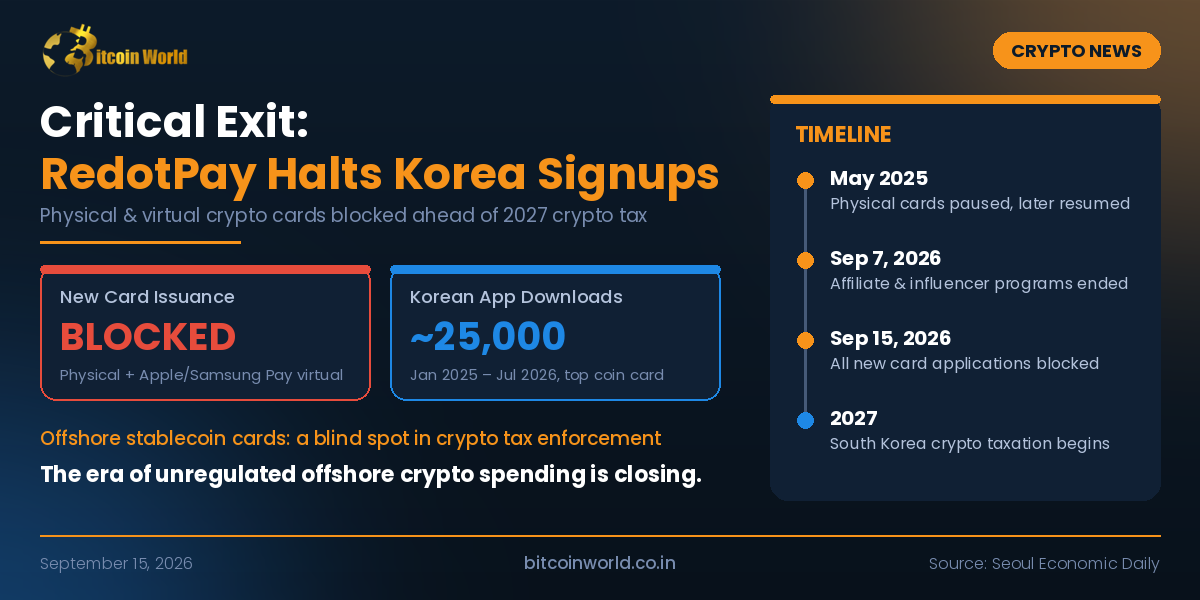
RedotPay has stopped issuing both physical and virtual crypto cards to new users in South Korea.
The company ended its Korean affiliate and influencer referral programs on September 7, days before the block surfaced.
This is the platform’s second Korean pullback. The first, in May 2025, only covered physical cards.
The move comes just months before South Korea’s crypto taxation regime begins, and offshore stablecoin cards have been flagged as a tax-enforcement blind spot.
For many Korean crypto holders, RedotPay offered a simple way around the country’s strict separation between digital assets and everyday banking. You loaded Tether (USDT) into an app, added a virtual card to Apple Pay or Samsung Pay, and spent at any Visa merchant. That route is now closed to newcomers. Anyone in Korea who tries to apply is told that card applications are temporarily unavailable in their region.
Why this matters
The retreat itself is less important than when it happened. South Korea plans to begin taxing crypto gains next year. Stablecoin spending is taxable too, because every card swipe can quietly realize a gain. The problem for authorities is that transactions on an offshore Hong Kong platform cannot easily be tracked in real time. RedotPay was the most popular product in this category: its app was downloaded roughly 25,000 times in Korea between January 2025 and July 2026, more than any rival coin card.
RedotPay has not publicly explained its decision. The sequence of events, however, looks like a deliberate wind-down rather than a technical glitch. When a company cuts its marketing channels first and then closes onboarding, it usually expects regulatory friction and is limiting its exposure before that friction arrives.
Timeline
January 2025: RedotPay’s Korean download growth begins in the tracked period.
May 2025: New physical card issuance is halted in Korea. Virtual cards remain available.
Later in 2025: Physical card issuance resumes after several months.
July 2026: Korean downloads reach about 25,000.
September 7, 2026: Affiliate programs with partners and influencers are terminated.
September 15, 2026: Reports confirm a full block on new physical and virtual cards.
2027: South Korea’s crypto taxation is scheduled to take effect.
The expert view
Blocking virtual cards is the telling detail. Virtual cards are cheap to issue and were the product’s growth engine, so cutting them points to a compliance calculation rather than a cost-saving one. Offshore payment firms increasingly understand that serving a market without local licensing becomes riskier once tax authorities start looking for gaps.
What comes next
Existing users should expect closer scrutiny, and possibly future limits on how they use their current cards. Demand will not disappear, though. It is likely to shift toward smaller offshore competitors, peer-to-peer channels, or, ideally, domestic won-based stablecoin products operating inside Korea’s regulatory perimeter. Regulators may also press card networks such as Visa over how cross-border crypto spending is monitored.
Conclusion
RedotPay’s exit signals where Korea’s crypto market is heading. The era of loosely regulated offshore spending tools is ending, and oversight tied to taxation is taking its place. For users, convenience now carries compliance risk. For the industry, the message is that growth in Korea will increasingly depend on working with local regulators rather than around them.
This post RedotPay Shuts Its Door in South Korea as the Crypto Tax Clock Ticks first appeared on BitcoinWorld.
